
Bhagwa Pomegranate, India’s Export Variety
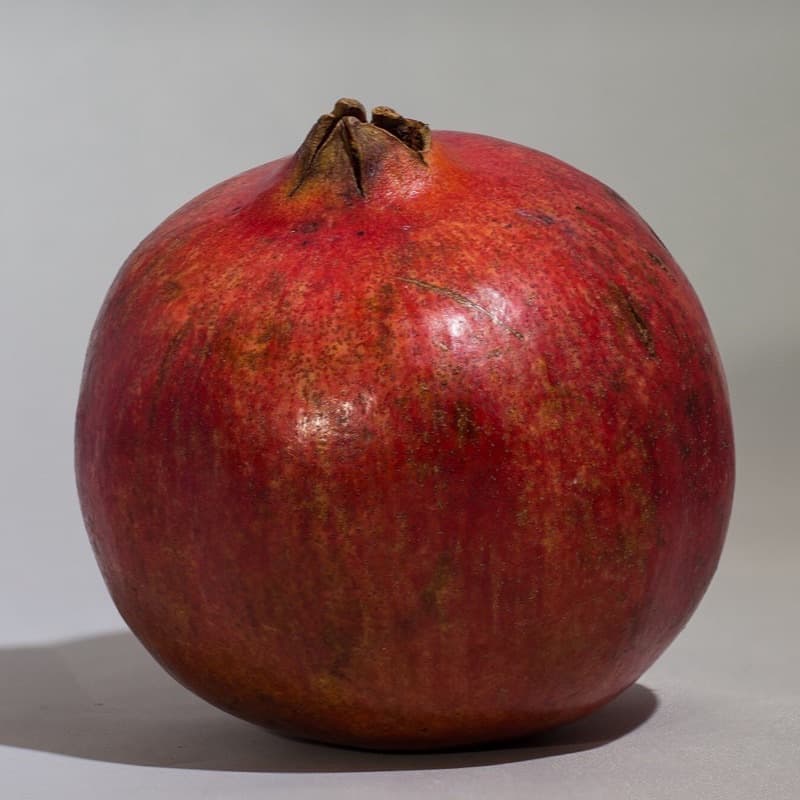
Bhagwa is the pomegranate variety global buyers ask for: saffron-red skin, soft seeds, deep-red arils and the shelf life needed for sea shipment. Aarvoyage Global Exim exports fresh Bhagwa pomegranate sourced from the main producing belts of Maharashtra and central India.
Fruit is harvested at export maturity, sorted for 200–400 g count sizes, and packed in 3–4 kg corrugated boxes with individual fruit separation. Reefer containers at 5–7°C give up to two months of storage life, allowing sea shipment to the Gulf, Europe and Asia in full condition.
For European buyers we supply against destination MRL requirements with pre-shipment residue testing available. All shipments carry phytosanitary certificates and certificates of origin, with APEDA-compliant traceability.
It is worth knowing what grading actually looks for, because it is what separates export fruit from the same orchard’s domestic-market crop. Graders assess skin colour and finish, rejecting sun-scald patches and scarring; count-size uniformity, so a carton presents consistently rather than mixing grades; crown condition, since the calyx is both a freshness cue and a common entry point for decay; and freedom from cracking, which disqualifies fruit outright and is driven by irrigation irregularity late in the growing cycle. Ask any supplier what proportion of a block makes export grade. One who measures it will give you a number.
Availability follows the bahar flowering cycles rather than a single annual harvest, which is why Indian pomegranate is obtainable across most of the year but not uniformly. The Mrig cycle, harvesting from roughly November to February, carries the largest export volume and the strongest colour, and is the window most programmes are built around. Hasta bahar extends supply into the spring. Because growers commit orchard blocks to a cycle months ahead, buyers who indicate volume before a window opens are consistently better served than those arriving mid-season looking for containers.
At a Glance
- Variety
- Bhagwa
- Fruit size
- 200–400 g, count-size graded
- Packing
- 3–4 kg corrugated boxes
- MOQ
- 3 Metric Ton
- Key markets
- UAE, Bangladesh, Netherlands, UK, Nepal, Russia
- Season
- Main harvest Aug–Feb (Mrig & Hasta bahar)
Pomegranate Products
Frequently Asked Questions
Why is Bhagwa the preferred pomegranate variety for export?
Bhagwa combines attractive deep-red skin and arils with a thicker rind and longer shelf life than other Indian varieties, making it the standard for sea-freight export to the Gulf and Europe.
What fruit sizes do you supply?
We grade fruit into count sizes from roughly 200 g to 400 g+. Gulf markets commonly take 250–300 g fruit, while European buyers often prefer larger 300 g+ grades.
Can you export pomegranate to Europe?
Yes. EU shipments are supplied against destination MRL norms with residue testing available before shipment, along with phytosanitary certification and full traceability.
When is Indian pomegranate available through the year?
Growers induce flowering in one of three cycles, called bahars, which between them spread fruit across most of the year. Mrig bahar harvests from roughly November to February and carries the largest export volume with the strongest colour. Hasta bahar supplies the spring window. Treat these as planning ranges rather than fixed dates, since they shift by weeks with rainfall and temperature.
How long does the fruit hold after shipment?
Shipped in reefer containers at 5 to 7°C and handled properly from the packhouse, Bhagwa holds around two months. That is what makes sea freight viable to the Gulf, Europe and Asia rather than requiring air. The figure assumes an unbroken cold chain: time spent warm early in the journey is deducted from shelf life at the far end and cannot be recovered by cooling harder later.
Can you supply buyer-branded cartons?
Yes, on confirmed orders. Standard packing is 3 to 4 kg corrugated boxes with fruit separated to prevent bruising. Buyer artwork, labelling to your market’s requirements and alternative box sizes can be arranged, but tell us before production rather than after, since packaging is ordered ahead of the harvest window.
What is the minimum order quantity for pomegranate?
Three metric tons. Because pomegranate ships in reefer containers and the freight economics favour fuller loads, larger volumes price better per kilogram. For a first order we would generally rather you took a smaller quantity and tested the relationship than committed to a programme before seeing the fruit.
Can I appoint my own inspection agency before shipment?
Yes, and we would encourage it on a first order. Buyers routinely appoint SGS, Intertek or an equivalent agency at their own cost to inspect at the packhouse or at stuffing. No supplier serving export markets should object to third party inspection, and reluctance to allow it is worth treating as a warning sign.
How is pomegranate priced through the season?
Price tracks the bahar cycle in production and the grade you specify. Fruit at the front of a window, from the main Mrig harvest, is generally both better material and better priced than fruit drawn from the tail of a cycle, when a higher proportion of the crop falls outside export grade and grading to a tight tolerance costs more.
What causes pomegranate to be rejected at destination?
Most commonly cracking, which disqualifies fruit outright, decay entering through a damaged crown, and colour or size falling outside the agreed grade. All three are addressable by specifying grade and tolerance in writing, appointing inspection at loading, and agreeing in advance how arrival condition is assessed and by whom.
Buyer guides: Pomegranate
All export guides →Indian Pomegranate Export Season: Bahar Cycles and Availability
Indian pomegranate is available for most of the year, but not continuously. Understanding the three bahar cycles tells you when to buy and when supply tightens.
ShippingIncoterms for Fresh Produce: Who Pays When Cold Chain Fails
The Incoterm decides who pays for the reefer and who carries the loss if the temperature slips. Most fresh-produce buyers discover which, only after a container arrives warm.
MarketsImporting Fresh Produce from India to the UAE
The UAE is the shortest serious export route out of India for fresh produce. What the trade looks like in practice: routes, paperwork, duty and timing.