
Aflatoxin and Pesticide Limits for Chilli from India
The contaminant limits dry and fresh chilli from India must meet in the EU, UK and US, what changed at the EU border in 2026, and how to write them into a purchase contract.
Key takeaways
- In the EU, dried chilli and chilli powder may contain no more than 5 µg/kg of aflatoxin B1, 10 µg/kg of total aflatoxins and 20 µg/kg of ochratoxin A.
- Since 30 June 2026 the EU no longer applies increased border checks for aflatoxin to chilli from India. The limits themselves still apply.
- Dried chilli from India is checked at the EU border for pesticide residues, specifically ethylene oxide, on 20% of consignments.
- Fresh chilli from India is in the EU’s stricter Annex II: each consignment needs an official certificate with laboratory results, and 30% are checked.
- The UK has required an official pesticide-residue certificate for chilli under CN code 0904 since 7 March 2024. In the US, the FDA’s action level for total aflatoxins in food is 20 µg/kg.
Chilli is one of the products most often stopped at import borders, and the reasons are nearly always the same two: mould toxins that develop when chilli dries or is stored badly, and pesticide residues above the importing country’s limits. Both are measurable, both can be written into a purchase contract, and both are far cheaper to control before a container is stuffed than after it is detained.
This guide sets out the limits that apply in the EU, the UK and the US, the changes to EU border controls on Indian chilli during 2026, and the clauses worth putting in a contract. Regulations change, so confirm the current position with your customs broker before a first shipment.
What are the limits for chilli in the EU, UK and US?
The EU and UK set legal maximum levels for aflatoxins in dried chilli, and the EU also sets one for ochratoxin A. The US works through an FDA action level for food in general rather than a chilli-specific limit. The table summarises the position for dried chilli as of October 2026.
| Market | Aflatoxin B1 | Total aflatoxins | Ochratoxin A | Border regime for chilli from India |
|---|---|---|---|---|
| European Union | 5 µg/kg | 10 µg/kg | 20 µg/kg | Dried: ethylene oxide checks on 20% of consignments. Fresh: Annex II, official certificate and lab results, 30% checked |
| United Kingdom | 5 µg/kg | 10 µg/kg | Confirm with your importer | Official certificate of pesticide-residue sampling and analysis for CN 0904, since 7 March 2024 |
| United States | No separate limit | 20 µg/kg (FDA action level for food) | No FDA action level | Pesticide residues must fall within US tolerances |
What is the EU limit for aflatoxin in chilli?
Under Commission Regulation (EU) 2023/915, dried Capsicum, whole or ground and including chillies, chilli powder, cayenne and paprika, may contain no more than 5.0 µg/kg of aflatoxin B1 and 10.0 µg/kg of the sum of aflatoxins B1, B2, G1 and G2. The same regulation sets 20 µg/kg of ochratoxin A for dried Capsicum, slightly above the 15 µg/kg that applies to most other dried spices.
These limits apply to the product on sale in the EU, whatever border checks are in force. A lot that tests above them cannot legally be marketed, and the regulation does not allow a non-compliant lot to be mixed with a compliant one to bring it under the limit.
What changed for Indian chilli at the EU border in 2026?
Two regulations amended Implementing Regulation (EU) 2019/1793, the EU’s list of goods subject to increased border controls, during 2026.
- From 18 February 2026, under Regulation (EU) 2026/194, dried, crushed or ground chilli from India (CN 0904) moved from the stricter Annex II to Annex I, with identity and physical checks on 20% of consignments for pesticide residues. The regulation specifies those residues as ethylene oxide.
- From 30 June 2026, under Regulation (EU) 2026/1206, the EU removed the increased aflatoxin checks on chilli from India, which had applied since May 2019, concluding that an increased level of official controls was no longer justified.
Neither change relaxes the limits. Aflatoxin in Indian chilli is now checked under normal EU controls rather than at a fixed increased rate, and a consignment that fails is still refused. For a buyer, the practical effect is fewer routine border holds for aflatoxin testing, not a lower standard.
Why is ethylene oxide on the list?
Ethylene oxide is a gas used in some countries to sterilise spices and seeds against microbial contamination. It is not authorised for that use in the EU, where residues are measured together with its breakdown product, 2-chloroethanol, and it has been behind large recalls of seed and spice products in recent years. The current EU border check on dried Indian spices under CN 0904 is specifically for ethylene oxide residues.
For a buyer, the clause to add is straightforward: the goods have not been treated with ethylene oxide at any stage, and the supplier will provide residue test results to prove it on request.
What does Annex II mean for fresh green chilli?
Fresh chilli from India, other than sweet peppers, is listed in Annex II of Regulation (EU) 2019/1793 for pesticide residues, with 30% of consignments checked at the border. Annex II goods can enter the EU only under special conditions.
- Each consignment must be accompanied by the results of sampling and analysis carried out by the competent authorities of the country of origin.
- The analyses must be performed by laboratories accredited to ISO/IEC 17025.
- An official certificate, following the model set out in the regulation, must be issued by the competent authority of the exporting country.
- The certificate is valid for no more than four months from issue, and no more than six months from the date of the laboratory results.
This is why fresh chilli for the EU cannot be shipped at a day’s notice. Sampling, analysis and certification have to be built into the time between harvest and loading, on a product that holds only around two weeks of saleable life.
What does the UK require?
Since 7 March 2024, chilli and chilli products exported to the UK under CN code 0904 have needed an official certificate stating that the goods were sampled and analysed and comply with maximum residue levels for pesticides. The requirement came from the UK’s 2024 regulation on high-risk food and feed of non-animal origin. In response, the Spices Board of India introduced mandatory sampling of UK-bound chilli consignments for pesticide residue analysis, on top of its existing aflatoxin testing, and issues a health certificate for them.
According to the Spices Board’s March 2024 circular, five samples are drawn from each consignment: two laboratory samples, a counter sample, an appeal sample and one for the exporter. Ask your supplier for the test reports and the certificate number before the goods sail.
Where does aflatoxin in chilli come from?
Aflatoxins are produced by moulds, chiefly Aspergillus flavus and Aspergillus parasiticus, that grow on crops kept warm and damp. In chilli the risk concentrates at two points: slow drying after harvest, and storage or transit at high humidity. Chilli dried quickly on clean surfaces and kept dry afterwards rarely develops a problem; chilli dried slowly on bare ground, or rewetted by rain, is where most failures begin.
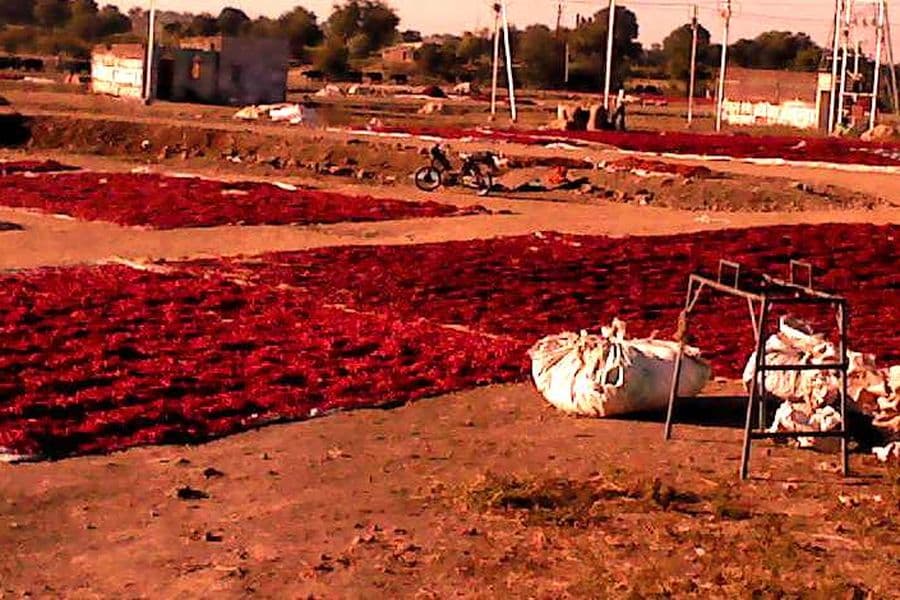
This is also why moisture belongs in a chilli contract. Cold-chain references recommend holding dried chilli at 60–70% relative humidity, and note that controlling humidity matters more than holding an exact storage temperature.
What should a chilli purchase contract specify?
Put the limits in the contract as numbers, tied to the law of the destination market, and agree how compliance will be proven. A workable set of clauses covers the following.
- Maximum aflatoxin B1, total aflatoxins and ochratoxin A, stated as the destination market’s legal limits or tighter.
- Pesticide residues within the maximum residue levels of the destination market. In the EU, a pesticide without a specific limit defaults to 0.01 mg/kg.
- A statement that the goods have not been treated with ethylene oxide.
- A maximum moisture content, tested before shipment.
- Testing at a laboratory accredited to ISO/IEC 17025, with the sampling method named.
- Counter samples retained by both sides, and an agreed referee laboratory if results disagree.
- Who pays for retesting, and what happens to a lot that fails.
A supplier who has shipped to regulated markets before will already hold most of these documents. If a supplier is reluctant to commit to them in writing, treat that as useful information. Our comparison of Indian chilli varieties covers the colour and heat side of the same specification.
Sources & further reading
- Commission Regulation (EU) 2023/915 on maximum levels for certain contaminants in food · EUR-Lex
- Commission Implementing Regulation (EU) 2019/1793 · Increased official controls and special conditions of entry, EUR-Lex
- Commission Implementing Regulation (EU) 2026/194 · 28 January 2026, EUR-Lex
- Commission Implementing Regulation (EU) 2026/1206 · 9 June 2026, EUR-Lex
- Spices Board of India, Circular 17/2023-24 · UK high-risk food regulation and chilli testing, 14 March 2024
- Action levels for poisonous or deleterious substances in human food and animal feed · US Food and Drug Administration
- WFLO Commodity Storage Manual: Peppers, Dry Chili · Global Cold Chain Alliance
Frequently asked questions
What is the EU limit for aflatoxin in chilli powder?
5 µg/kg for aflatoxin B1 and 10 µg/kg for total aflatoxins (B1, B2, G1 and G2), under Regulation (EU) 2023/915. The same limits apply to whole dried chillies, chilli powder, cayenne and paprika.
Does the EU still apply extra aflatoxin checks to chilli from India?
No. Regulation (EU) 2026/1206 removed the increased aflatoxin checks on Indian chilli from 30 June 2026. The legal limits still apply, and dried chilli is still checked for ethylene oxide residues on 20% of consignments.
What is the US limit for aflatoxin in spices?
The FDA uses an action level of 20 µg/kg (20 ppb) for total aflatoxins in human food. It is guidance on when the FDA may take enforcement action, rather than a spice-specific legal limit.
Do I need a certificate to import Indian chilli into the UK?
Yes. Since 7 March 2024, chilli under CN code 0904 must be accompanied by an official certificate showing it was sampled and analysed for pesticide residues. In India, the Spices Board samples UK-bound consignments and issues a health certificate.
What is the EU limit for ochratoxin A in chilli?
20 µg/kg for dried Capsicum, including chillies, chilli powder, cayenne and paprika, under Regulation (EU) 2023/915. Most other dried spices have a lower limit of 15 µg/kg.
What causes aflatoxin in dried chilli?
Moulds, chiefly Aspergillus flavus and Aspergillus parasiticus, growing on chilli that dries slowly or is stored damp. Fast, clean drying and storage at around 60–70% relative humidity are the main controls.
Sourcing from India?
Products covered in this guide
Grades, packing specifications and container capacities for each, or send us your destination port and quantity for a quotation.
More guides
Byadgi, Teja or Guntur? Choosing Indian Dry Red Chilli
Colour and heat are separate properties and they live in different varieties. Which one you need decides everything else, including what you should be paying.
Red ChilliASTA Colour Value: What to Specify When Buying Dry Red Chilli
Colour and heat are separate properties, measured separately, and the best chilli for colour is rarely the best for heat. What to put in your specification.
ShippingReefer Temperatures for Onion, Banana, Pomegranate and Chilli
The setpoint, humidity and vent settings for each fresh product we ship, why a reefer cannot rescue warm fruit, and the chilling injury that only shows up at destination.
CompliancePhytosanitary Certificates from India: A Buyer’s Guide
What the certificate actually proves, who issues it in India and how, the faults that get consignments held, and how to check one before your goods arrive.