
Byadgi, Teja or Guntur? Choosing Indian Dry Red Chilli
Colour and heat are separate properties and they live in different varieties. Which one you need decides everything else, including what you should be paying.
Chilli is India's largest spice export by value, worth roughly 1.3 billion US dollars in 2024 to 2025 and around a quarter of the entire spice export basket. A buyer approaching that market for the first time is offered a list of variety names, usually without being told what actually separates them. This guide is that missing explanation, written from the Spices Board of India's own published values rather than from supplier marketing.
The single idea that makes the rest of it simple: colour and heat are separate properties, measured separately, and the varieties that excel at one are usually unremarkable at the other. Decide which of the two your product needs, and the choice narrows immediately.
The official numbers
The Spices Board of India publishes reference values for its catalogued varieties. These are the most authoritative figures available and they are worth knowing, because supplier quotations often differ from them.
| Variety | ASTA colour | Capsaicin | Region | Season |
|---|---|---|---|---|
| Byadgi (Kaddi) | 159.9 | Negligible | Dharwad, Karnataka | January to May |
| Kashmir chilli | 54.1 | 0.325% | J&K, Himachal, north India | November to February |
| Guntur Sannam (S4) | 32.1 | 0.226% | Andhra Pradesh, Telangana | Main crop from February |
Read the first column carefully. Byadgi carries roughly five times the extractable colour of Guntur Sannam and roughly three times that of Kashmir chilli, while its capsaicin is described by the Board as negligible. That is the whole trade-off in one line.
Byadgi: buy it for colour
Byadgi is the colour variety. At around 160 ASTA against Guntur Sannam's 32, it is what buyers reach for when a finished product needs deep red colour without the heat that would come with it. Its principal industrial use is oleoresin extraction, where the capsanthin pigment is the commercial product, and it is equally the choice for masala blends and any application judged on appearance.
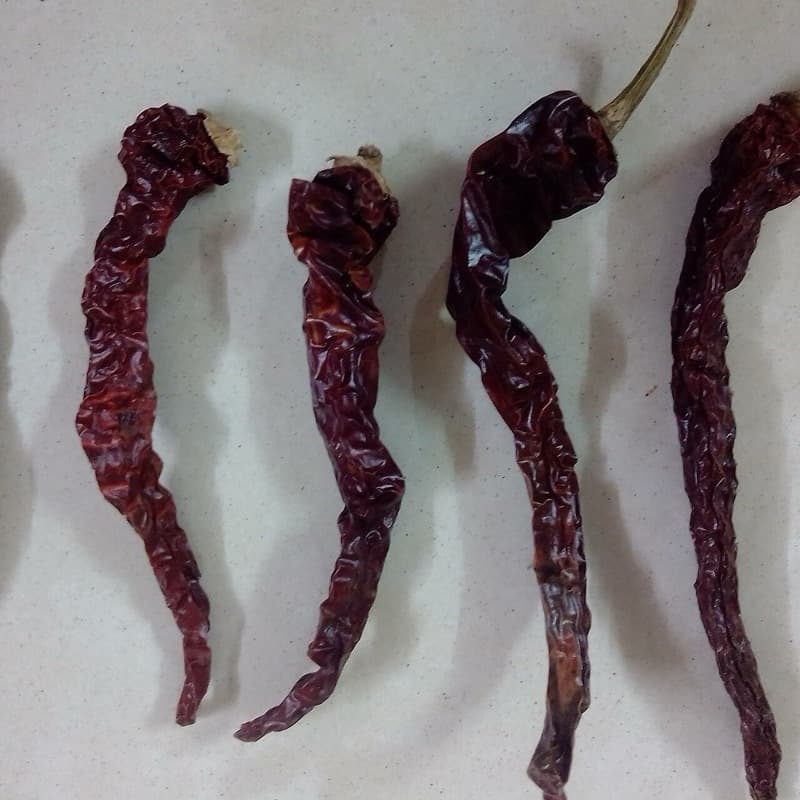
One nuance that under-specified contracts miss: Byadgi holds a Geographical Indication, granted in 2011, covering two distinct types. Dabbi is short and plump with more seeds and lower pungency, and is the type extraction buyers and established masala manufacturers generally prefer. Kaddi is long, thin and heavily wrinkled with fewer seeds. Writing simply "Byadgi" on a purchase order leaves that choice to your supplier.
Expect to pay for it. Byadgi production runs at roughly 21,000 tonnes a year against Guntur Sannam's 280,000, it is restricted to a small Karnataka belt, and the premium that follows is structural rather than seasonal.
Teja (S17): buy it for heat
Teja is the pungency variety, grown mainly across Andhra Pradesh and Telangana with Khammam the largest producing district. It is the feedstock behind much of the hot sauce and capsaicin extraction trade and moves in volume to China and Bangladesh for exactly that purpose.
Published pungency figures for Teja vary more than any other variety in this guide. Sources cluster between 50,000 and 100,000 Scoville units, with capsaicin reported around 0.5 to 0.7 per cent, and occasional marketing claims well above that which are best ignored. Treat 50,000 to 100,000 as the working band and require lot certification if your formulation depends on the number.
Its colour is unremarkable. Supplier specification sheets commonly quote Teja in the region of 60 to 80 ASTA, though no government or research source confirms that band, so treat it as indicative. The directional point is safe and it is the useful one: Teja gives heat, not colour, which is precisely why it is blended rather than used alone where appearance matters.
Guntur Sannam (S4): the reference variety
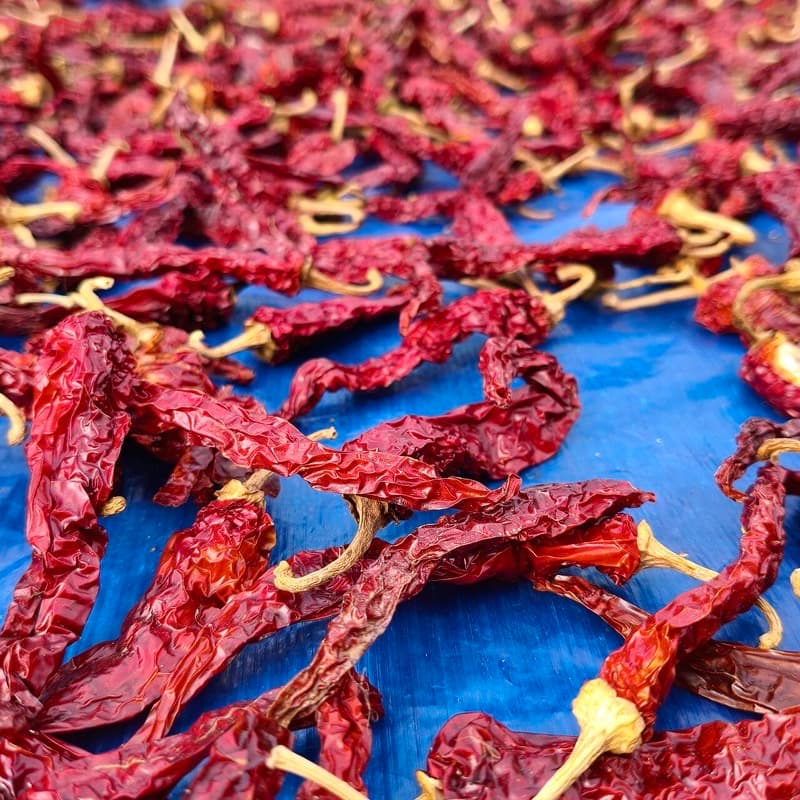
Sannam is the volume variety and the commercial benchmark. At roughly 280,000 tonnes annually it dwarfs every other catalogued Indian chilli, and the Guntur Mirchi Yard, Asia's largest dried chilli market with daily arrivals routinely above 100,000 bags, sets the reference price that most Indian offers are quoted against.
Its official values put it in the middle on both axes: 32.1 ASTA and 0.226 per cent capsaicin, with the Board describing it as thick-skinned, hot and red. That thick pericarp has a practical consequence buyers sometimes miss, because it means better grinding yield and more body in powder.
For a continuous programme rather than an occasional purchase, the depth of supply is worth more than a marginal advantage in colour or heat from a scarcer variety. Large orders fill without difficulty and pricing is transparent.
A word about "Kashmiri" chilli
This deserves stating plainly because it causes genuine confusion. In international trade, "Kashmiri chilli" usually describes a style, deep red colour with restrained heat, rather than guaranteeing chilli grown in Kashmir.
Chilli actually grown in the region is mild, broad and fleshy, and produced in small quantity. Because demand exceeds that supply by a wide margin, Byadgi is routinely used in its place, and independent Indian consumer testing has found this substitution to be widespread. This is normal trade practice rather than misdescription, but it means the name alone tells you less than you might assume.
If you need chilli of genuine Kashmir origin, say so explicitly at the enquiry stage so it can be sourced and documented as such. If what you actually need is the colour profile, you are probably better served specifying Byadgi and an ASTA minimum directly.
Checking a lot on arrival
You do not need instruments to tell these varieties apart. The physical differences are distinct enough for a receiving warehouse to verify by eye.
| Variety | Length | Skin | Colour |
|---|---|---|---|
| Byadgi (Kaddi) | Long, slender | Deeply wrinkled, gnarled | Deep dark red to maroon |
| Teja (S17) | Short, roughly 5 to 10 cm | Smooth, glossy, pointed tip | Bright red |
| Guntur Sannam (S4) | Medium | Thick, moderately smooth | Bright to darker red |
Smooth and short where you ordered long and wrinkled is worth a conversation before the container is accepted.
Blending is normal, not a compromise
Because colour and heat sit in different varieties, buyers needing both routinely blend rather than hunting for a single lot that delivers both. Byadgi with Teja is the classic pairing, and suppliers describe delivering contracted values across a wide range by adjusting the ratio.
The practical instruction is to give your supplier the target values rather than the ratio. The ratio depends on what the current crop is actually testing at, which changes season to season, so a ratio fixed in a contract will drift away from the specification it was meant to hit.
The varieties nobody publishes numbers for
Honesty is more useful here than completeness. Several grades traded as Indian dry red chilli have no published technical provenance at all.
- S10 is traded as a Guntur-belt medium-heat grade, usually quoted alongside Sannam and 334. Figures circulating for it come from trader specification pages with no government, research or standards corroboration.
- Syngenta 5531 is a hybrid seed variety, described consistently by seed retailers as medium pungency with attractive deep red dry colour and a medium wrinkled surface, but its published colour and heat figures trace to a single trade source.
- Endofy appears only on Indian B2B supplier listings. Repeated searching found no ASTA value, no Scoville value, no growing region and no seed company or research provenance for it.
None of that makes these grades unusable. It does mean the variety name is carrying no verifiable information, so a contract for them should specify colour, pungency, moisture and defect tolerance in numbers and require testing, rather than relying on the name to define the goods.
What to put in the contract
- Minimum ASTA colour value, with the test method named.
- Pungency as SHU or capsaicin percentage, whichever your process uses.
- Maximum moisture, since dry chilli held too wet risks mould and aflatoxin over a long sea transit.
- Aflatoxin limit, set by your destination market rather than by the origin.
- Stem or stemless, which affects usable weight and how material runs on a processing line.
- Maximum broken and damaged percentage.
- Who tests, at which accredited laboratory, and what happens if a lot falls outside.
Give us those seven lines and a destination port and we can quote against the current crop the same day. Tell us the end use as well, because buying for extraction rather than culinary sale changes what we look for in a lot.
Sources & further reading
- Spices Board of India, chilli variety catalogue · official ASTA colour and capsaicin reference values by variety
- Spices Board of India, itemwise export statistics · chilli export volumes and values
- Press Information Bureau, Government of India · spice export totals for 2024 to 2025
- ICAR Indian Institute of Spices Research · research body for Indian spice crops
- IBEF, spice industry and export in India · sector overview and export context
Sourcing red chilli?
We export red chilli from India
See grades, packing specifications and container capacities, or send us your destination port and quantity for a quotation.
More guides
ASTA Colour Value: What to Specify When Buying Dry Red Chilli
Colour and heat are separate properties, measured separately, and the best chilli for colour is rarely the best for heat. What to put in your specification.
Red ChilliAflatoxin and Pesticide Limits for Chilli from India
The contaminant limits dry and fresh chilli from India must meet in the EU, UK and US, what changed at the EU border in 2026, and how to write them into a purchase contract.
ShippingReefer Temperatures for Onion, Banana, Pomegranate and Chilli
The setpoint, humidity and vent settings for each fresh product we ship, why a reefer cannot rescue warm fruit, and the chilling injury that only shows up at destination.
CompliancePhytosanitary Certificates from India: A Buyer’s Guide
What the certificate actually proves, who issues it in India and how, the faults that get consignments held, and how to check one before your goods arrive.